
The 7-Part System That Turns Buyers Into Brand Defenders
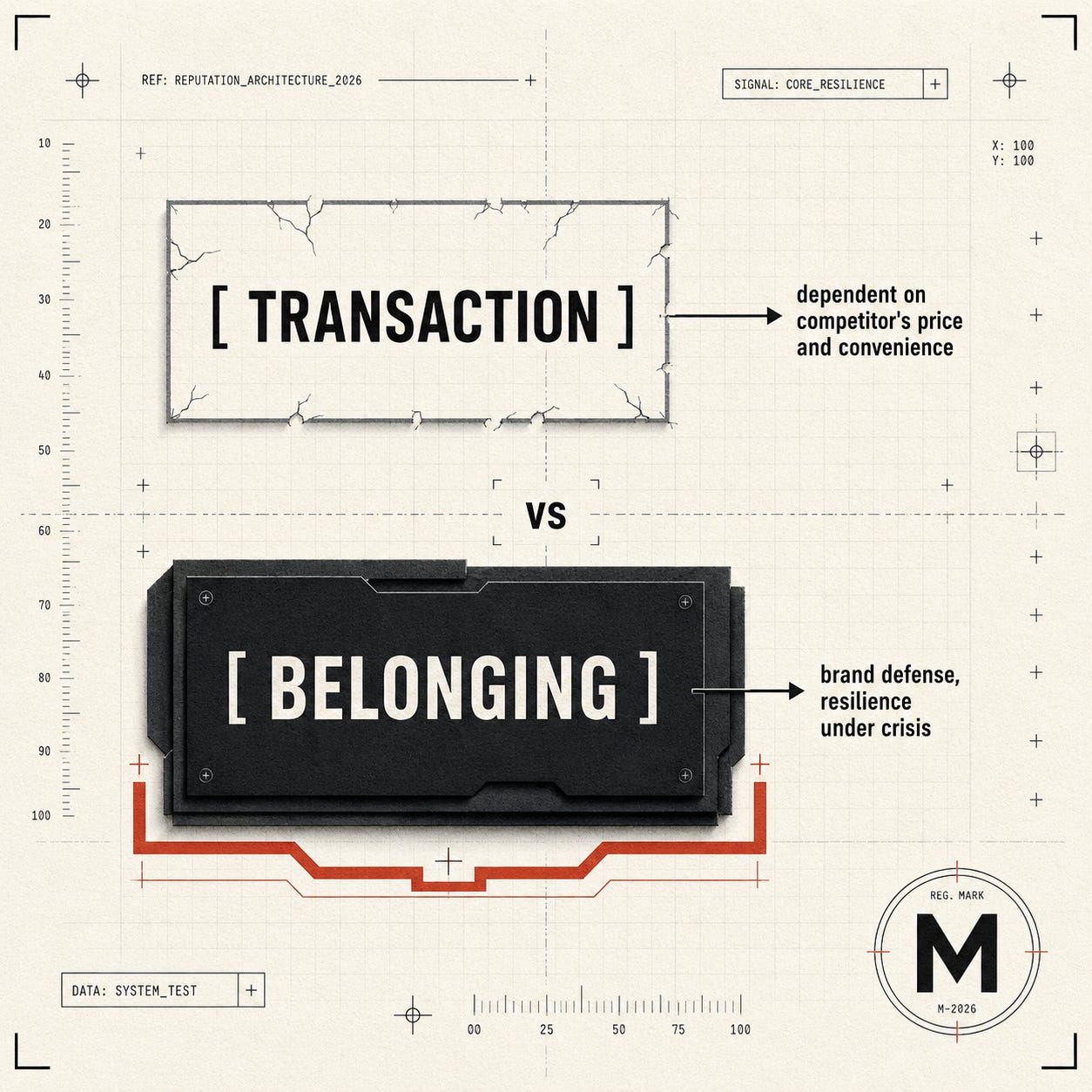
Loyalty programs have become one of the most popular business simulacra of the past twenty years. The problem isn’t that they’re useless. The problem is that they’re often mistaken for loyalty itself.


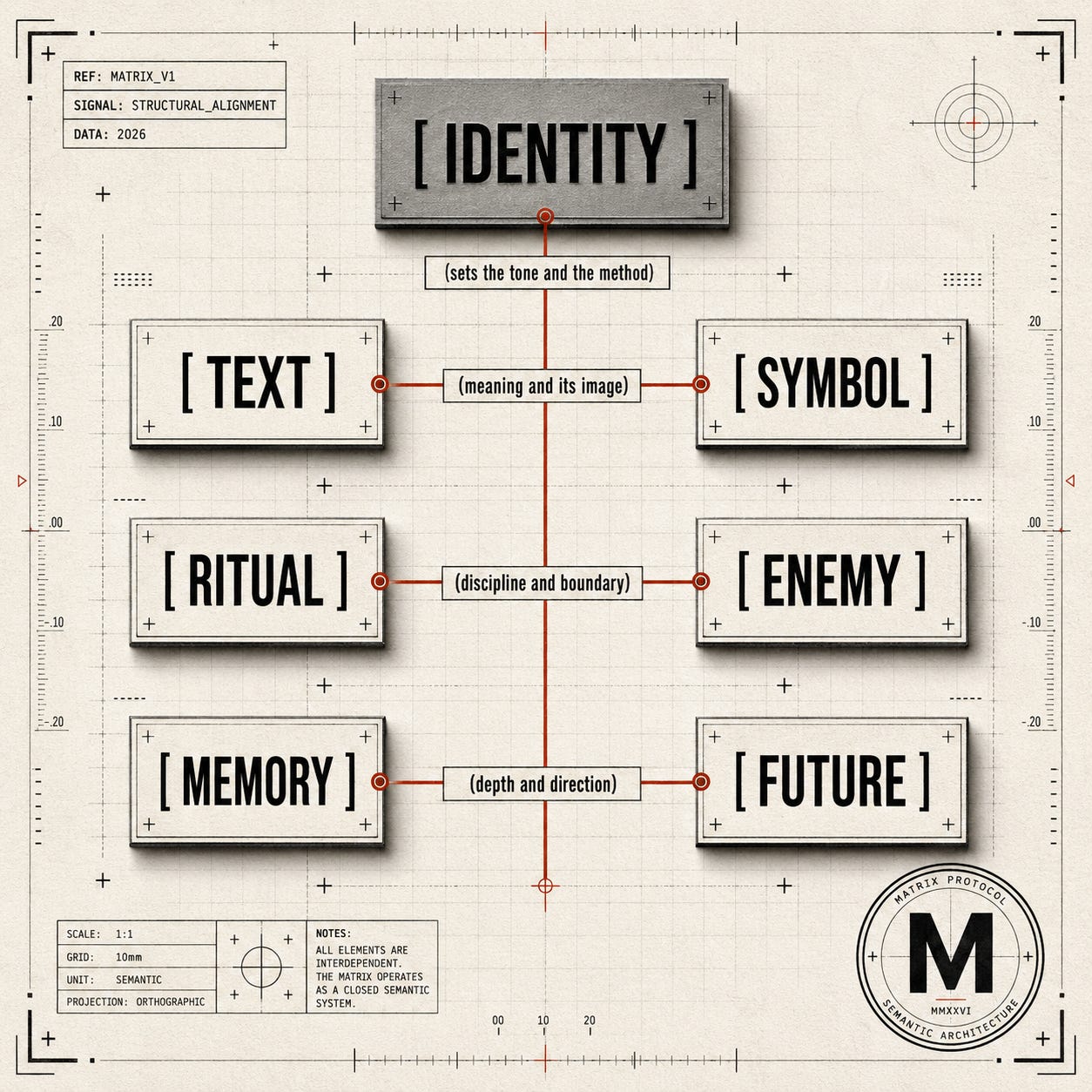
TL;DR: Most companies confuse transactional convenience with brand devotion. That confusion leaves them critically exposed to price wars. Real belonging isn’t bought with discounts. It’s engineered through seven nodes: Identity, Text, Symbol, Ritual, Enemy, Memory, and Future. Audit and integrate them, and a founder can turn a fragile firm into a self-replicating system that outlives its creator.
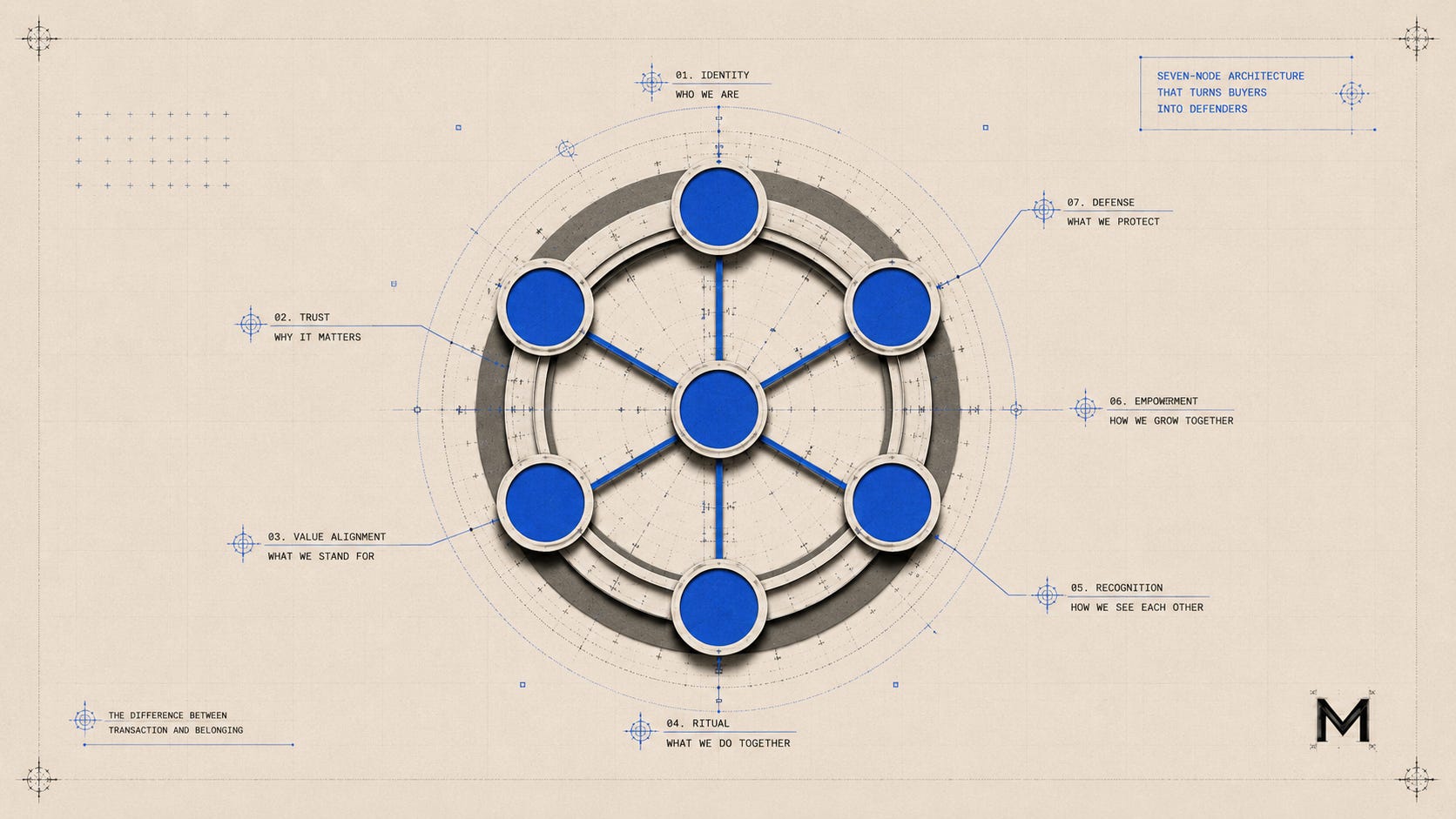
One caveat before reading: the seven-node architecture isn’t a substitute for product, operational discipline, or quality. No mythology saves a bad product. This frame doesn’t explain how to win the market. It explains why some companies stay vendors and others become systems of belonging.
The transactional trap: loyalty as paid attention
Most founders build a business on raw transaction. Money in, product out. The arithmetic works perfectly in Excel and breaks the moment a real market shows up. The instant a competitor appears who is noticeably cheaper or more convenient, a slice of the customer base walks out without regret. They had no real reason to stay.
A customer can be held in place by a contract, a habit, an integration, or the absence of an alternative. None of that is loyalty. It is friction. When the friction goes, the customer goes with it.
Economists call this market inertia. It is really a failure of systems design.
Humans are herd animals whose brains spent thousands of years scanning for safety in a group. We look, unconsciously, for markers of belonging: our language, our sign, our place, our people. Inside a strong brand, the customer isn’t only buying a function. He is buying belonging. A competitor cutting three percent off the price can’t sell that.
The gap between a successful brand and an anonymous storefront isn’t only about product quality. Quality buys you the right to be considered. Belonging buys you the right to be remembered.
A mercenary is bound by his contract. A man of the regiment is bound by his standard, his memory, and his brothers. The same logic applies to a customer who shares a company’s values. He defends the brand in arguments. He stays when prices go up. Real loyalty isn’t bought with bonuses. It is engineered.
Six levels of maturity: the difference between a person and a mannequin
To understand how a business becomes a durable historical structure, it helps to separate the stages of its evolution.
Most founders dream of a global empire while still thinking like a corner shop. For this analysis, take six levels of maturity. Each step requires another element of a living organism.
The Firm. A legal entity, a bank account, a lease. The minimum skeleton needed to trade. No money, no firm. It disappears quietly, and nobody comes to the funeral.
The Brand. A visual style, a logo, a voice. The product becomes recognizable. The wrapper can still be empty inside.
The Organization. The business builds structure, job descriptions, processes. The machine runs well, but it has no broader meaning yet.
The School. The critical mental shift happens here. A school doesn’t transmit tasks and functions to its employees and customers. It transmits a method and a way of thinking. It shapes a particular kind of person, the way McKinsey shapes its alumni and Toyota shapes its engineers.
The Movement. The idea takes hold without direct operational control from the founder. People carry the brand’s values forward because those values have become part of who they are.
The Empire. The company stops adjusting to the market’s standards. It writes the standards. Everyone else either follows them or burns resources fighting.
Picture an old pasticceria in Palermo. The cassata recipe barely changes. The signboard has seen several generations. The same customers walk in every Sunday after Mass. Around it, ultra-modern cafés keep opening with contactless payment and flawless design, and keep closing two years later. The new café sold transaction. The old pastry shop sells belonging. It is alive. It has a face, a memory, rituals, a character. It grew into a school and a movement while the neighbors stayed faceless firms.
Anatomy of the seven nodes: how to assemble a working engine
The shift from a transactional firm to a self-organizing empire doesn’t happen through bigger budgets. It happens when seven core nodes fire at once. For this analysis, we’ll call the construction the Unity Machine.
It isn’t a statistical model and it isn’t a formula for guaranteed growth. It is a diagnostic frame. It shows where a company imitates belonging and where it actually creates the conditions for it. When several nodes are missing or exist only as imitation, the system goes brittle. It can sell, but it holds people, meaning, and trust badly.
I. Identity (the first magnet)
The founder isn’t an object of worship. The founder is the first carrier of the method and the person who takes risks no one else will take.
Ray Kroc was 52 when he walked into the McDonald brothers’ small kitchen in San Bernardino and saw a scalable system. In 1961, he bought their company outright for $2.7 million. Identity sets the standard of behavior.
Apple survived the loss of Steve Jobs not only on product momentum and an operational machine, but because some of his principles were already wired into the company: focus, a closed ecosystem, control over the product and the brand’s language.
II. Text (the constitution of the business)
Meaning can’t live only in the founder’s head. There it is exposed to fatigue, fear, and the pressure of circumstance. It has to be written down.
In 1943, Johnson & Johnson put its Credo on a single page and set a strict order of priorities: customers first, then employees, then community, and shareholders last.
In 1982, seven people in Chicago died from poisoned Tylenol capsules. The board pulled 31 million bottles off shelves nationwide and ate roughly $100 million in losses. The decision was made fast because the Credo had already ranked the priorities: customers first, everything else after. Within a year, the brand had recovered most of the market share it had lost. The text saved the business.
III. Symbol (the short form of power)
A symbol is a compressed message. It transmits in one second what a text would need a full page to say.
In the early 1980s, Harley-Davidson was in trouble. The company was losing on price, quality, and efficiency to Japanese manufacturers, and by 1985 it was sitting on the edge of bankruptcy. Symbols alone did not save Harley. Restructuring did. So did quality work, the dealer network, and temporary import protection. But the symbol gave the brand something a tariff could not buy. Harley kept what most of its competitors didn’t have: a symbol of freedom, rebellion, and American identity. Japanese brands won on the engine spec sheet. Harley answered with a way of life. For some customers, the logo stopped being a manufacturer’s mark and became a mark of the self.
A real symbol always lets the customer announce something about himself to the world without saying a word.
IV. Ritual (the discipline machine)
A procedure answers the question of how to do it and produces people who follow instructions mechanically.
A ritual answers the question of why it matters and produces believers.
At IBM under Thomas Watson Sr., sales wasn’t a function. It was the cultural core of the company. The best salesmen were publicly recognized, rewarded, and turned into a behavioral standard through the Hundred Percent Club, internal training, and ceremonies of recognition. An honest weekly review of mistakes, with no scapegoating and no punishment, will build a culture of precision faster than any outside training. One year is usually enough. Whatever repeats every week becomes your real culture.
V. Enemy (drawing the boundary)
The enemy in this model isn’t a person, and it isn’t a group of people. It is a boundary: chaos, mediocrity, expense, dishonesty, bureaucracy, customer pain. The system doesn’t need an enemy in order to spread hatred. It needs an enemy in order to reach clarity. What binds a strong leader and the team around him is a shared “against.” Since 1971, Southwest Airlines’ strategic enemy has been expensive aviation, which had turned flying into a privilege. The fight was with customer pain, not with a particular competitor.
When a brand chooses a direct competitor as its only enemy, it risks becoming derivative. Its language begins to depend on someone else’s center of gravity.
The Pepsi war with Coca-Cola shows both the power and the risk of that strategy. It builds recognition. It also chains the brand’s language to a rival’s center of gravity. The right enemy is immortal. Chaos, bureaucracy, mediocrity, none of them ever die, and the fight against them keeps feeding the company meaning.
VI. Memory (history as capital)
A company without memory has to start everything over every year.
In 1906, when San Francisco was destroyed by one of the strongest earthquakes in its history, Amadeo Giannini hauled the gold and silver of his Bank of Italy out of the fire zone, set up a temporary bank on a pier in North Beach, and started lending to victims on his word and a handshake. The story became permanent capital for the bank that later became Bank of America, and it shaped its character for a century. A written lineage of mistakes, victories, and crises proves to the team and to the market that what they are looking at isn’t a random signboard. It is a structure with a spine.
VII. Future (the strategic magnet)
A plan answers “what to do” and motivates only executors. A future answers “what for” and pulls living people in.
In 1961, Kennedy announced the goal of landing a man on the moon before the decade was out. NASA at that point had no finished rocket, no spacecraft, and no working chain of technology for a lunar landing. A concrete, tangible image of the future made people work at the limit of their capacity.
The future of your business has to describe in detail how customer lives and industry standards will change once you have won.
Clinical audit: diagnosing broken corporate machines
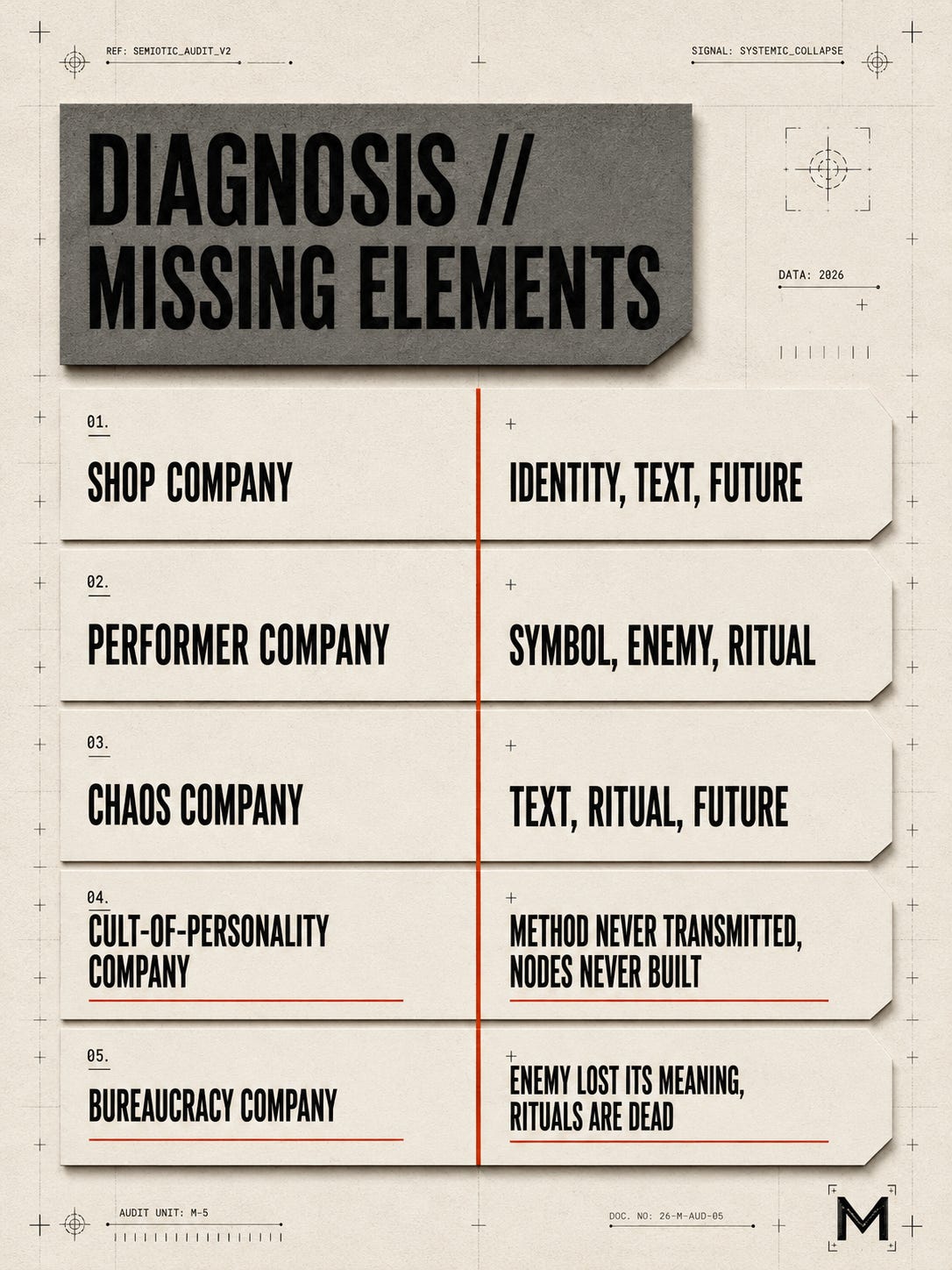
Every problem inside an organization, whether it is staff turnover, falling sales, or a reputation crisis, is only a symptom. The real cause usually lies in the absence of one or several elements in the seven-node matrix. Common clinical diagnoses:
The Shop Company. Excellent sales, no loyalty at all. Customers come for the low price and leave at the first opportunity. Employees work the shift and forget the company. Identity, Text, and Future are missing. Only cold transaction is left.
The Performer Company. A solid product, but nobody recommends the company with any enthusiasm and nobody defends it in public. Symbol, Ritual, and Enemy are missing. The business performs a function and has no identity.
The Chaos Company. A talented team and a sharp product, but no system. Decisions get made on the fly. People burn out quickly from the unpredictability. Text, Ritual, and Future are missing.
The Cult-of-Personality Company. The whole structure rests entirely on the founder’s charisma and energy. Without his personal involvement, processes stall. Identity is there, but the method was never transmitted. The other six nodes were never designed. The system is critically fragile.
The Bureaucracy Company. A mountain of regulations that paralyze initiative. Employees fear getting something wrong more than they want to do well. Living rituals long ago decayed into dead procedures, and the real Enemy, customer pain, has been replaced by a fight against internal risk.
And the reverse observation: seven nodes don’t guarantee survival. Nokia, Kodak, Blockbuster, and Sears weren’t empty signboards. They had symbols, memory, rituals, and an image of the future. At the critical moment, their future stopped being convincing to the market. Seven nodes don’t guarantee victory. Without them, belonging usually turns into decoration. The nodes have to be assembled and they have to be kept current.
Assembling the system: from functional service to historical body
When the seven elements are joined into a single architecture, the company makes a qualitative leap. It stops burning massive budgets on the constant task of forcing people into attention. The system starts to reproduce itself.
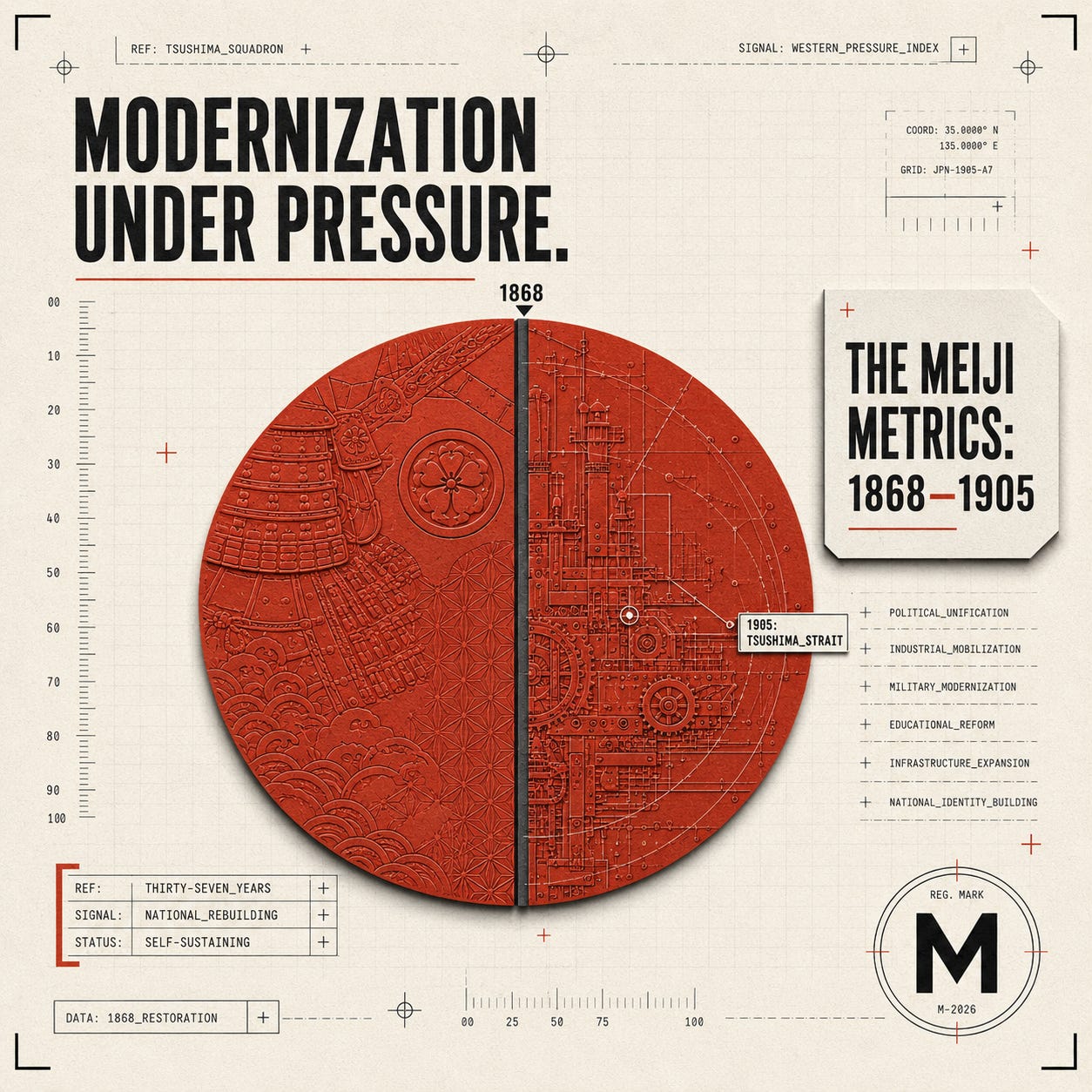
The state example is the loudest and also the hardest to transfer directly. In the late 1860s, Japan was leaving a feudal order and rebuilding itself, painfully, under pressure from Western powers. After the Meiji Restoration of 1868, the country ran one of the fastest national modernizations in modern history over thirty-seven years. In 1905, the Japanese fleet destroyed the Russian Empire’s squadron in the Tsushima Strait. The seven-node assembly reads cleanly:
Identity: Emperor Meiji as the living symbol of the nation.
Text: the new constitution of 1889 and the education code.
Symbol: one national flag, one military uniform, one anthem.
Ritual: compulsory military service and standardized schooling.
Enemy: the threat of colonization and the gap behind the Western powers.
Memory: the repackaging of the samurai inheritance into a new national ideology, with bushido as a late-Meiji ideological construct rather than a direct revival of an ancient code.
Future: Japan as a great world power.
One caveat: the state is not a corporation. It has a monopoly on violence, on taxation, and on compulsory education. A brand has none of those levers. So the mechanics of building a strong community are similar across scales, but they need adaptation. What works in a state through coercion works in business only through voluntary commitment. That makes corporate assembly technically harder, not easier.
In today’s oversaturated market, where everything that can be copied is being copied faster every year and service differences erode quickly, the winner isn’t whoever offers the best functionality. The winner is whoever people want to be around. The one who designed the system so that his business became their business too.
Seven nodes don’t make a business an empire. Without them, it stays a transaction, even when it calls itself a brand.
References
How Brands Become Icons: The Principles of Cultural Branding, Douglas B. Holt (Harvard Business School Press, 2004)
The Culting of Brands: Turn Your Customers into True Believers, Douglas Atkin (Portfolio, 2004)
Brand Community, Albert M. Muñiz Jr. and Thomas C. O’Guinn (Journal of Consumer Research, 2001)
Draw a Subculture: A Methodological Guide to the Study of Subculture, Oleg V. Maltsev (Patriot Publishing House, 2021)
Examining the Subculture Phenomenon: An Application of the Counter-Alternative Method, Oleg V. Maltsev (Newsletter on the Results of Scholarly Work in Sociology, Criminology, Philosophy and Political Science, 2021)
 | A guest post by
|
Really enjoyed this piece.
What stayed with me most is the distinction between transaction and belonging. A company can sell, grow, and even look successful for a long time while still remaining emotionally replaceable.
The seven-node framework gives a clear way to think about why some organizations become memorable while others remain just vendors.
Thank you for sharing such a thoughtful article.
Very useful article. Thank you for sharing it.
I'm currently working on a project of my own, and while reading this, I noticed that some of these principles are things I have been applying intuitively, while others were completely new to me. The framework helped connect several ideas that I hadn't previously linked together.
One question came to mind, though.
Most of the examples in the article involve either large companies or products with very broad appeal. Harley-Davidson is perhaps the closest example to a more defined tribe, but even motorcycles are still a relatively mainstream category.
How do you think these same seven nodes apply to highly niche projects, communities, or products with a very small target audience?
My intuition is that the principles themselves remain the same, but I'm wondering whether building a strong system of belonging becomes more difficult when the audience is small, or whether size is largely irrelevant and the same mechanisms work regardless of scale.
I'd be very interested to hear your thoughts on that.