

"2040": Chapter 5. The Blue Dot
Welcome to the world of my prognostic novel "2040" – a future that could come to pass… but absolutely should not.

You can read the previous chapter of “2040” by following the link.
Munich breathed evenly, almost without a sound. Winter here always tried to behave with good manners: a little snow, a little cold, a little squeal of tyres on morning asphalt, nothing excessive.
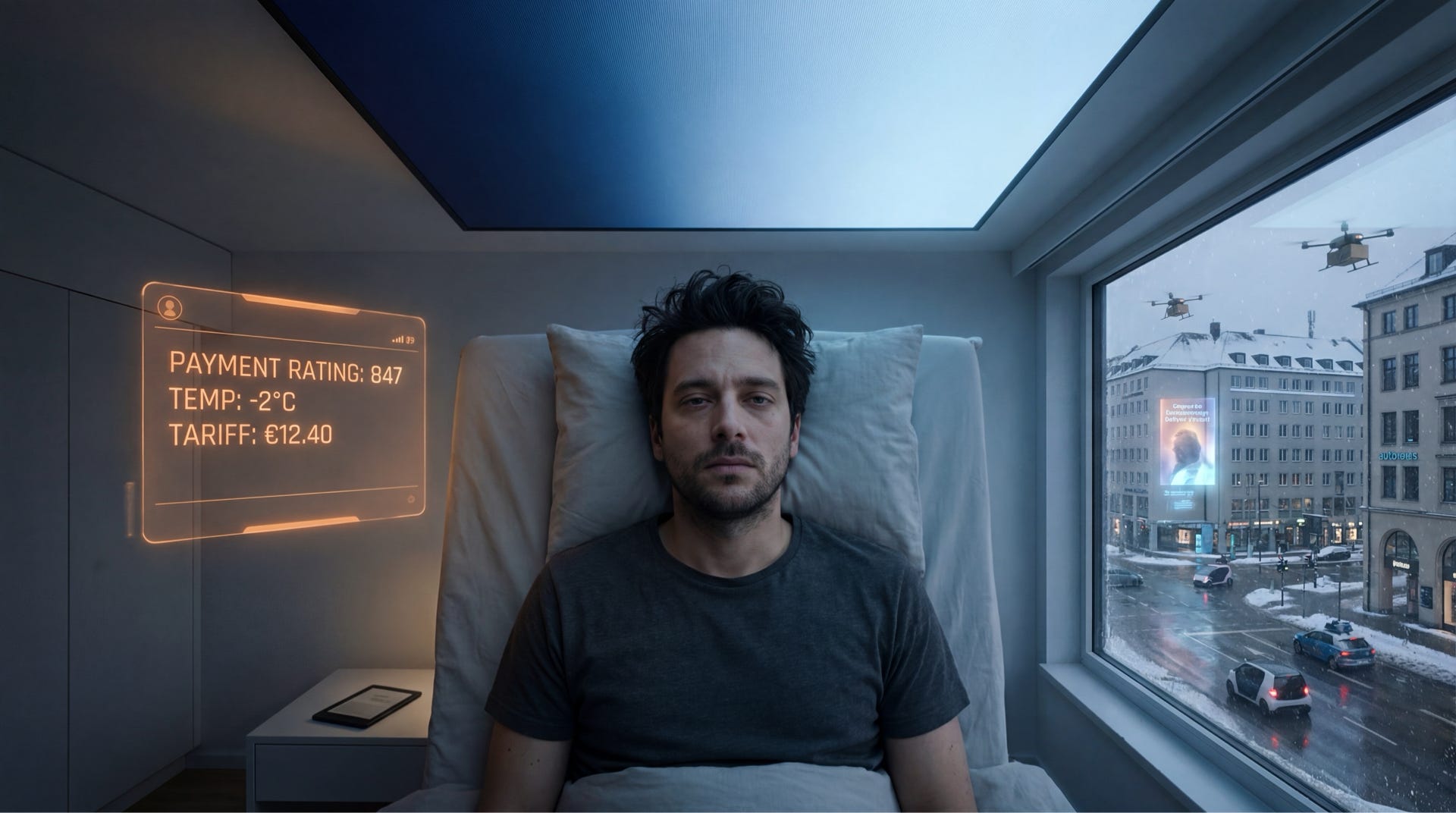
At six o’clock, the ceiling above Jamie’s bed slowly brightened, shifting from midnight navy to a washed out blue. The light tuned itself to his biorhythms like a caring mother on a monthly subscription.
— Good morning, Jamie, the apartment said. — January sixth, two thousand forty. Outside temperature: minus two. Your payment rating: eight hundred forty seven. Status: stable. Optimal day tariff: twelve euros forty cents. Recommended breakfast: oatmeal with blueberries, green tea.
Jamie Müller lay still for a moment. Listening. The assistant’s voice was unchanged: steady tone, polite diction, and a faint, almost imperceptible pride in his stable score.
He sat up and rubbed his wrist. On the bedside table lay an old e reader, offline, worn along the edges. It held people who, in 2040, officially did not exist.
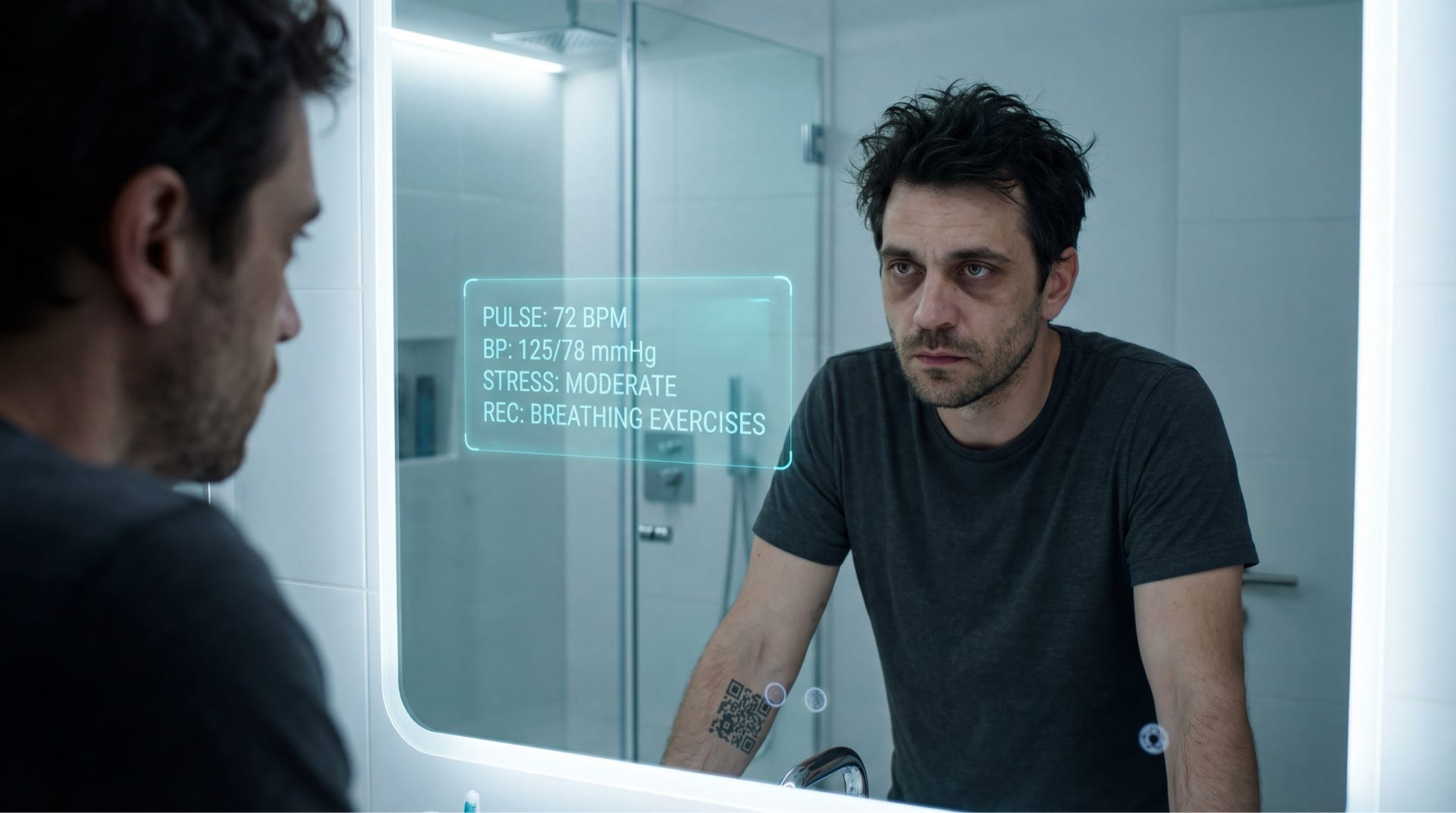
He got up and wandered into the bathroom. The mirror lit up the moment he crossed the threshold.
— Health scan complete, it reported warmly. — Pulse: seventy two. Blood pressure: one twenty five over seventy eight. Stress level: moderately elevated. Recommendation: three minutes of breathing exercises and reduce caffeine intake by twelve percent.
Jamie stared at his reflection. His dark hair had its own agenda, and his brown eyes looked as if the world had already managed to bore them three times before breakfast.
The mirror did not see the tattoo on his left forearm. The sleeve covered it completely. An old QR code, inked in Paris in twenty nine. Back then it had seemed funny. The code had led nowhere for nearly ten years, just like most promises from the era in which it was made.
The shower turned on by itself. Water flowed at the perfect thirty eight degrees. The system knew what felt “comfortable” to him.
— You have three notifications today, the apartment said while he stood under the stream. — First: your employer has confirmed your schedule for the week. Second: a sleep deviation has been recorded, you went to bed twenty three minutes later than usual. It is recommended that you return to the optimal regime. Third: your city transport subscription has been renewed automatically. Fourteen euros have been charged.
Twenty three minutes, he thought. God sees everything.
Only it was not God. It was the Agency.
The Harmont Financial Monitoring Agency, that was the official name of the place where he had the honour of being employed as an analyst. Half state, half supranational, an organ that watched over “the purity of payment flows”, “the timely detection of anomalies”, and “the maintenance of trust in the financial system”. In human language, it decided whose money moved correctly and whose looked suspicious.
PSD2, PSD3, PSD4, PSD5, all those regulatory hymns had merged into one continuous song, and the Agency had been dancing to it for over ten years. Jamie was part of the orchestra. Voluntarily. Almost.
He shut off the shower, dried himself, pulled on jeans and a sweater, and went to the kitchen.
The fridge, as always, greeted him with its door cocked like a shoulder.
— Recommended breakfast: oatmeal enriched with omega three, almond milk, protein bar, it announced cheerfully. — Calories: three hundred forty. Matches your daily limit.
— Of course it does, Jamie muttered.
He took the oatmeal. Ignored the bar. Ignored the almond milk with a deliberate, petty satisfaction.
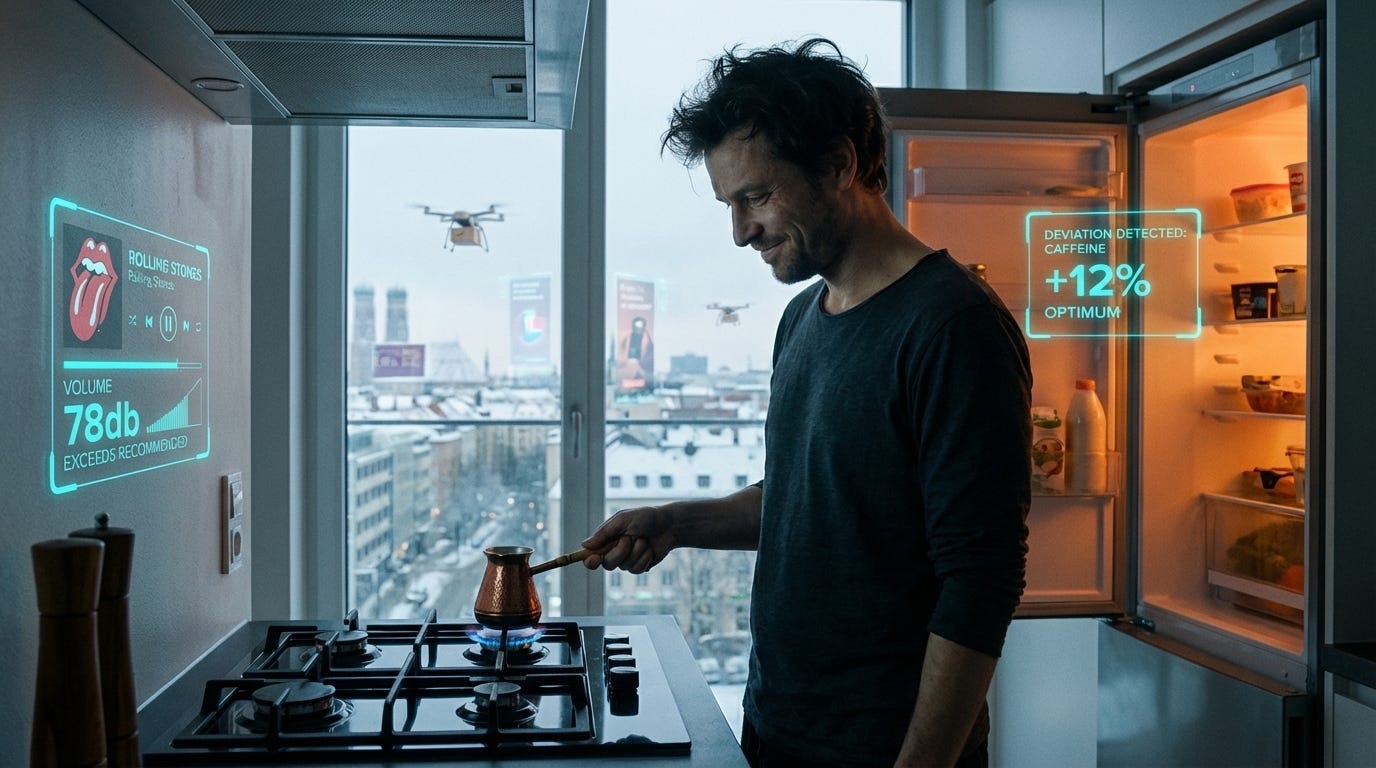
He pulled out a cezve, finely ground coffee, and an old fashioned gas burner.
— Deviation, the fridge said, concerned. — Coffee detected instead of recommended green tea. Caffeine intake exceeds optimum by twelve percent.
— Twelve percent, Jamie repeated. — Rebel.
He set the cezve on the stove and turned on the gas. Then he walked to the wall panel and tapped it with a finger.
— Music, he said. — Mine.
The panel hesitated for a moment.
— Local audio file detected: Rolling Stones, “No Filter 2039” concert, Wembley Stadium, it recited. — Reminder: Mick Jagger’s age at the time of recording was ninety six.
— Then play it.
A guitar burst into the kitchen like a break in. The stadium crowd roared as if the world had no intention of dying. Jagger rasped, babbled some nonsense between verses, and still sounded more alive than half the people Jamie knew.
— Your music choice does not match your morning health profile, the apartment persisted. — Decibel level: seventy eight. Recommended: forty five. Ambient is recommended.
— Shut up, Jamie said.
The panel blinked.
— Command not recognised. Please repeat…
He turned off voice mode with one movement. The Stones stayed. The world improved a little.
He ate oatmeal, drank coffee, and listened to old men who categorically refused to die.
Unique creatures, he thought. They are nearly a hundred and they still sound like they intend to turn the world upside down. What are they on. Who are their doctors. What insurance do they have. And why am I paying more for transport than they pay for eternity.
At seven fifteen he checked the time. At seven thirty two he needed to leave. At eight, the bookshop on Lindenstrasse. Max. The drive. Anna Kravchenko.
The Archivist had said, “He is not the type who runs after a sensation. He is the type who runs from the system.”
We’ll see, Jamie had replied then.
Now that “we’ll see” sounded a little less confident.
He turned off the music and pulled on a dark sweater. His smart jacket with the Agency logo hung on the hook in the hallway. He looked at it like the uniform of a foreign army.
He put it on anyway.
The sleeve covered the tattoo.
— Apartment exit: seven thirty two, the door announced as the lock clicked behind him. — Route to work: twenty three minutes. Attention: you are leaving eighteen minutes earlier than usual. It is recommended you clarify the purpose of the deviation.
— It is recommended you shut up, Jamie said. Quietly, more for himself.
The courtyard was silent. The snow lay neatly, as if placed by hand.
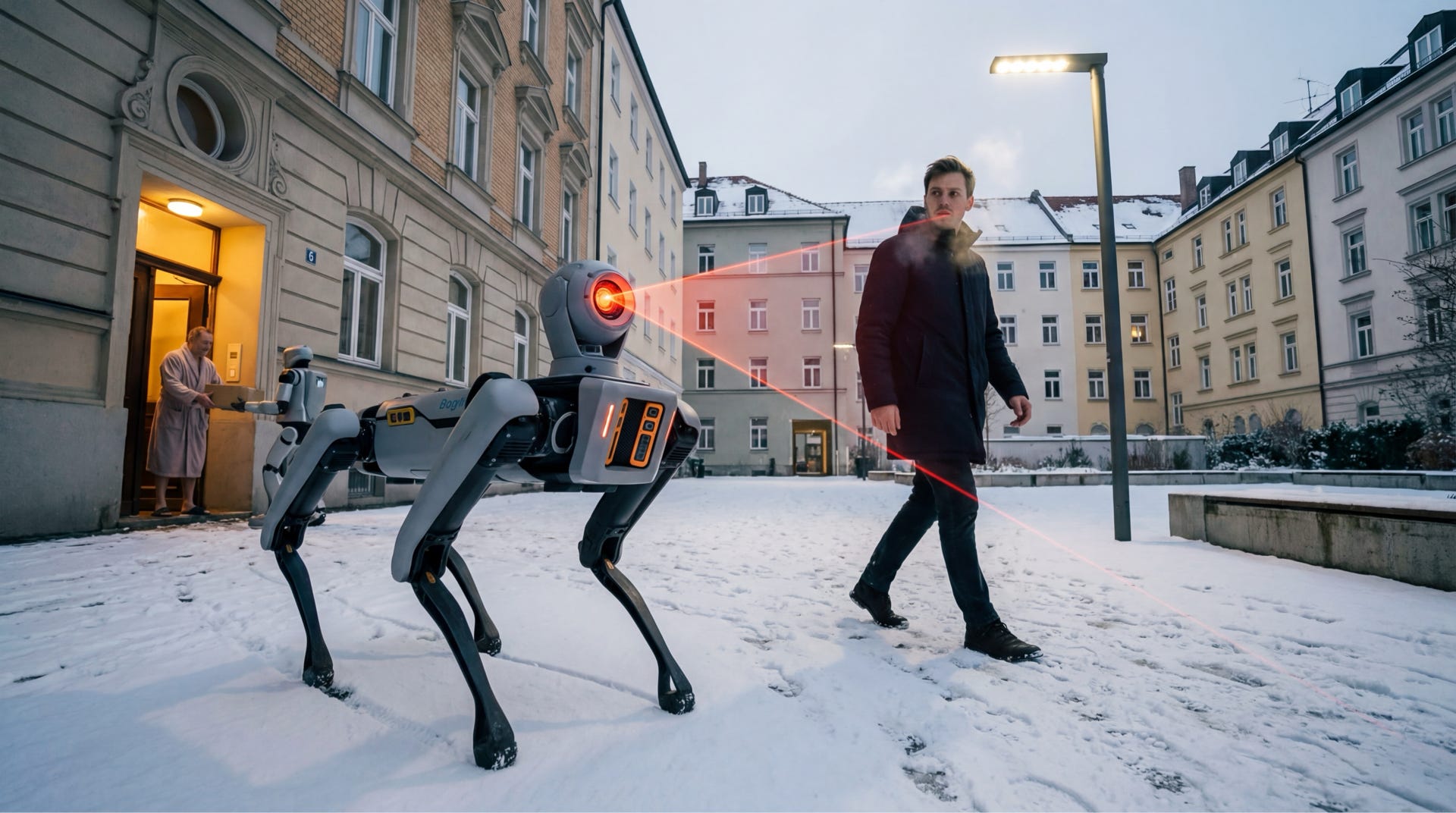
By the entrance stood a courier robot, four legged, grey, with a box strapped to its back. Where eyes should have been, a scanner glowed. The robot saw Jamie, tilted its “head”, assessed that he was not the target, and turned towards the neighbouring building.
The door opened and a neighbour came out in a dressing gown.
— Delivery for apartment twelve, the robot announced.
The neighbour placed his palm against the scanner, received the package, and disappeared. The robot trotted on, softly placing its metal paws.
There used to be couriers with backpacks here, Jamie thought. They complained about their knees. Now the knees do not complain. Progress has its perks.
At the corner, a streetlamp brightened as he approached and dimmed by half once he passed.
At an information panel, the screen flashed:
— Good morning, Jamie. Temperature: minus two. Road conditions: moderate ice. Recommended route: via Marienplatz. Time saved: three minutes.
He walked the other way. Through the courtyard, through an alley, past a wall where his gaze automatically built a ladder out of ledges and air conditioners. Paris had left strange reflexes in his head. Any vertical surface, he still measured on a simple scale: climbable or not.
Lindenstrasse met him with a light morning hum. Cafés were just opening, baristas wiped glass, delivery drones drifted past like slow mosquitoes.
Feder & Tinte looked as if someone had left it here by accident in the eighteenth century. A narrow door, darkened wood, a display window with books that had no QR codes and no promo codes.
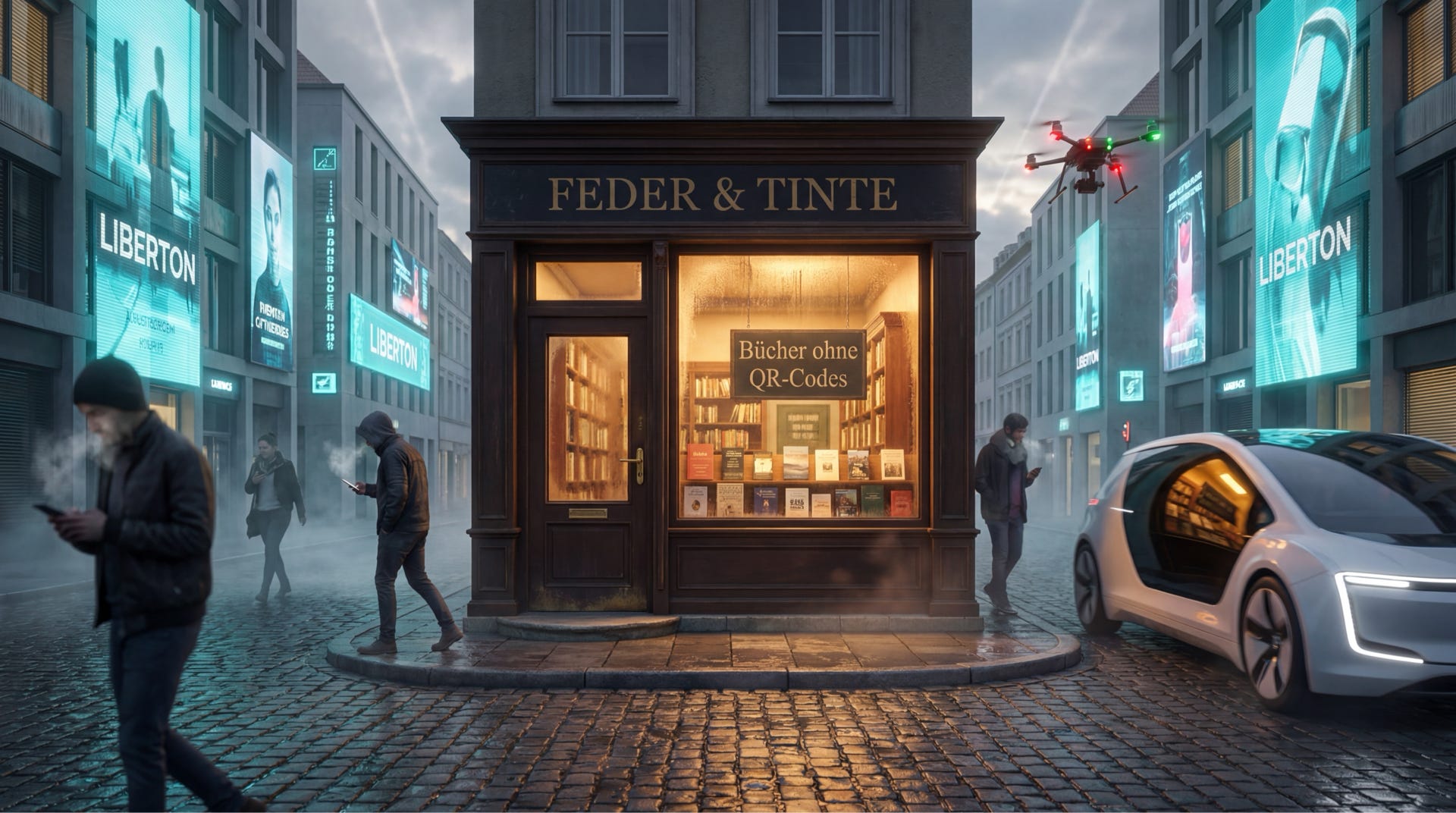
The bell above the door chimed like an old film.
Inside it smelled of dust, paper, and something else, maybe the impossibility of tracking purchases.
Max sat in the far corner at a table buried under books. His back to the wall, his face to the door, his attention everywhere at once.
Jamie walked over and sat opposite.
— Three minutes late, Max said.
— The system has to delight you with small surprises, Jamie said. — It asked questions about my route. I did not answer.
Max nodded.
— The Archivist said you know how to stay quiet.
He took a small metal case from his inner pocket and set it on the table.
— Anna Kravchenko’s drive.
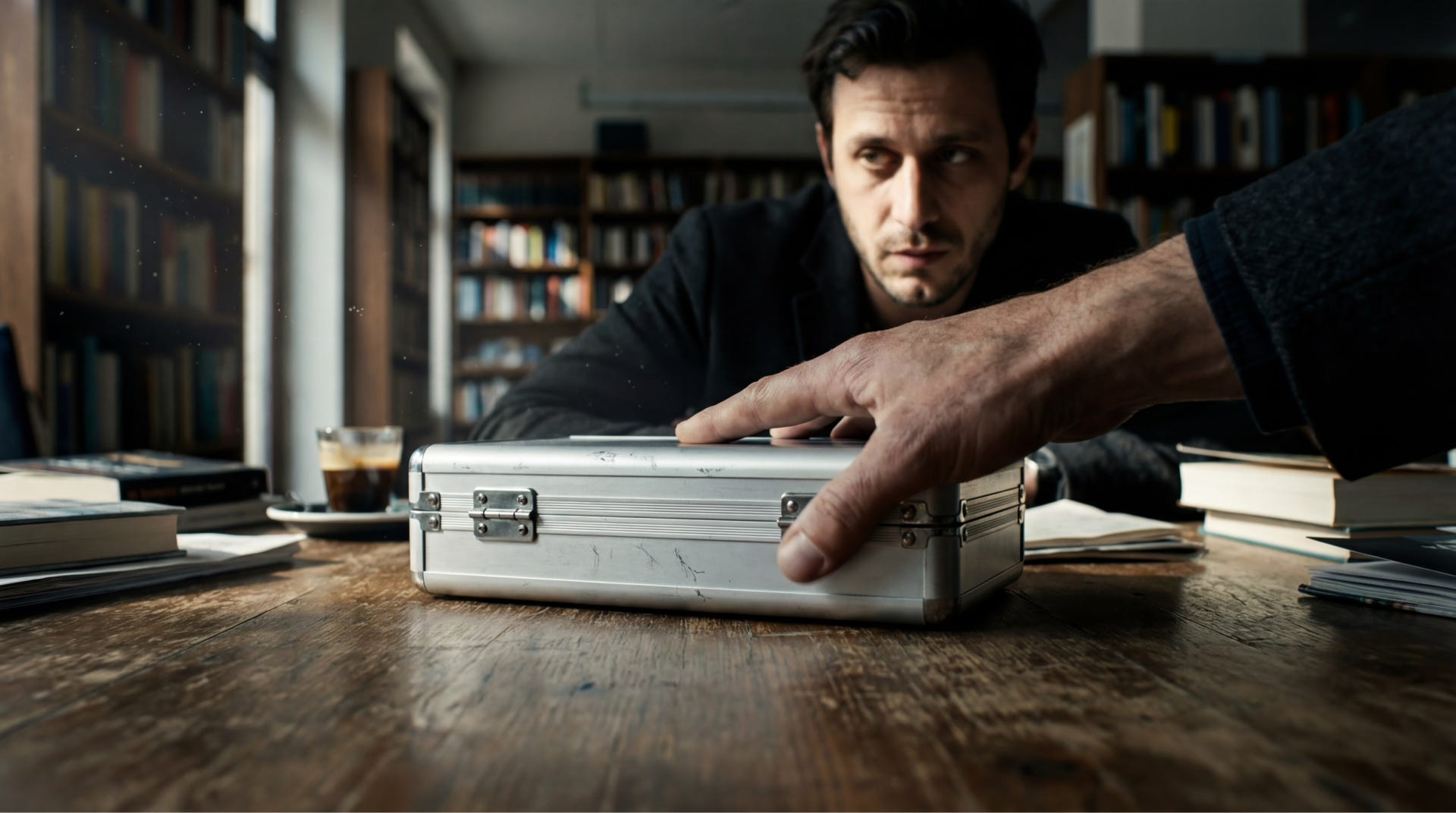
The metal felt cold. Jamie took the case, felt its weight, opened it. A plain flash drive. Plain, in the way an object can be plain when people vanish for it.
— What is on it, he asked.
— Documents. Messages. Internal protocols for PSD3 implementation and PSD4 drafts, Max said calmly. — Links between the Agency and the Commission. Names. Dates. Schemes. The original is on a hard drive. This is a copy, a compressed image plus encryption. I do not carry the original.
— Conspiracy, Jamie said. — I have heard stories like this twenty times. Half the time it was porn and messages with a mistress, and the other half it was instructions for a coffee machine.
— The Archivist said you can tell porn from war.
— The Archivist talks too much.
They fell silent.
— It is your choice, Max said. — If you want, you will look. If you do not, you will return it.
— How much time do I have.
— I do not know. People are already chasing this drive. I have heard at least three different requests in the last week.
— Who.
— People with something to lose.
It was not a bad answer.
— Fine, Jamie said. — I will look tonight. But if it is nonsense, you forget I exist.
— Agreed.
The S Bahn was almost empty. A morning train for people still pretending they had a nine to five day.
Jamie sat by the window. The carriage hummed softly. The few passengers held familiar postures, staring into familiar rectangles.
He took out his phone. Notifications from the Agency, from the city network, and from one social network he kept purely for the rating.
— Reminder: department meeting at fourteen hundred, Erica said in his ear in that built in voice. — Topic: strengthened monitoring of independent payment institutions, Electronic Money Institution.
The phone blinked. The screen went black, like the conscience of a minister.
— Hey, Jamie said quietly.
The phone came back on. But it was something else.
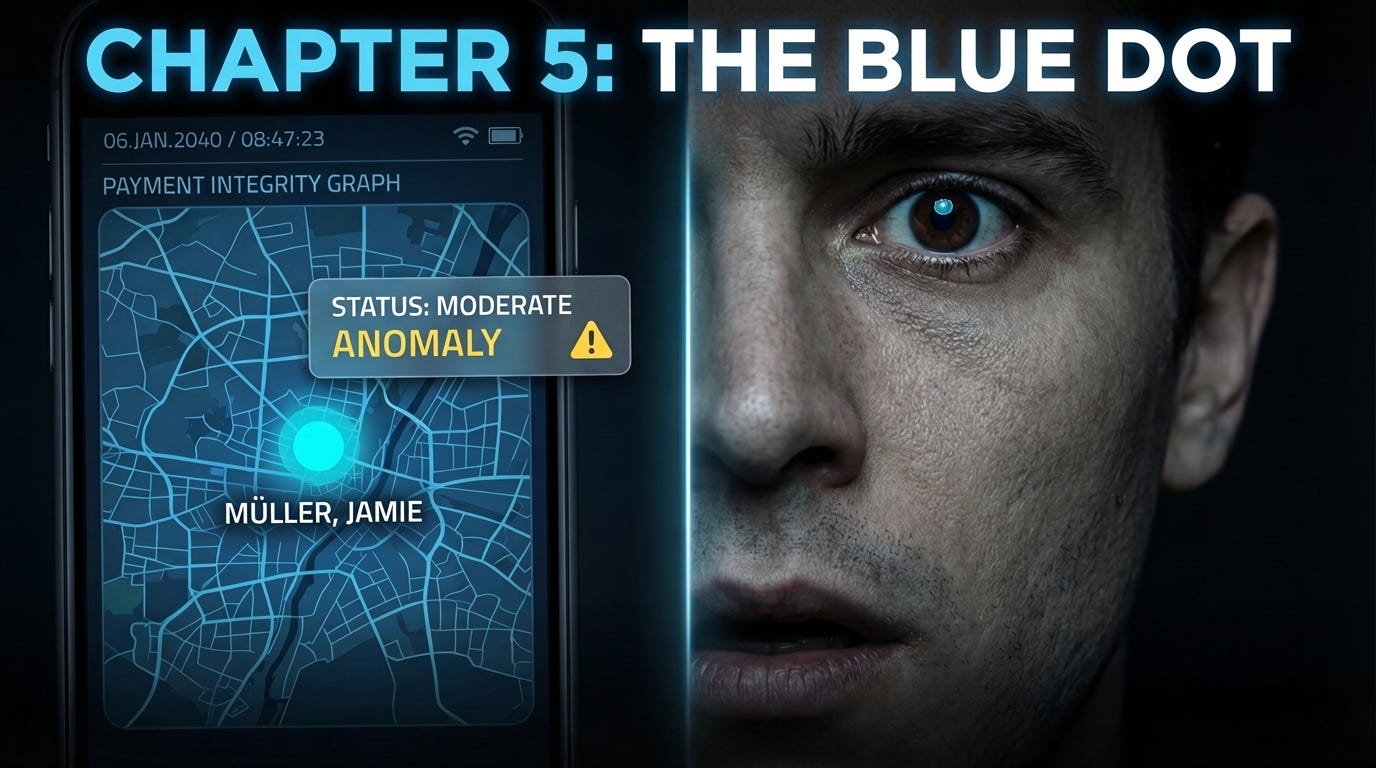
A dark background. At the top, in strict letters:
PAYMENT INTEGRITY GRAPH. ADMINISTRATIVE PANEL. MODULE: REAL TIME SURVEILLANCE.
A map of Munich. Like thermal imaging, except instead of heat, people. Dots in different colours: green, yellow, red, blue.
His fingers zoomed in on their own.
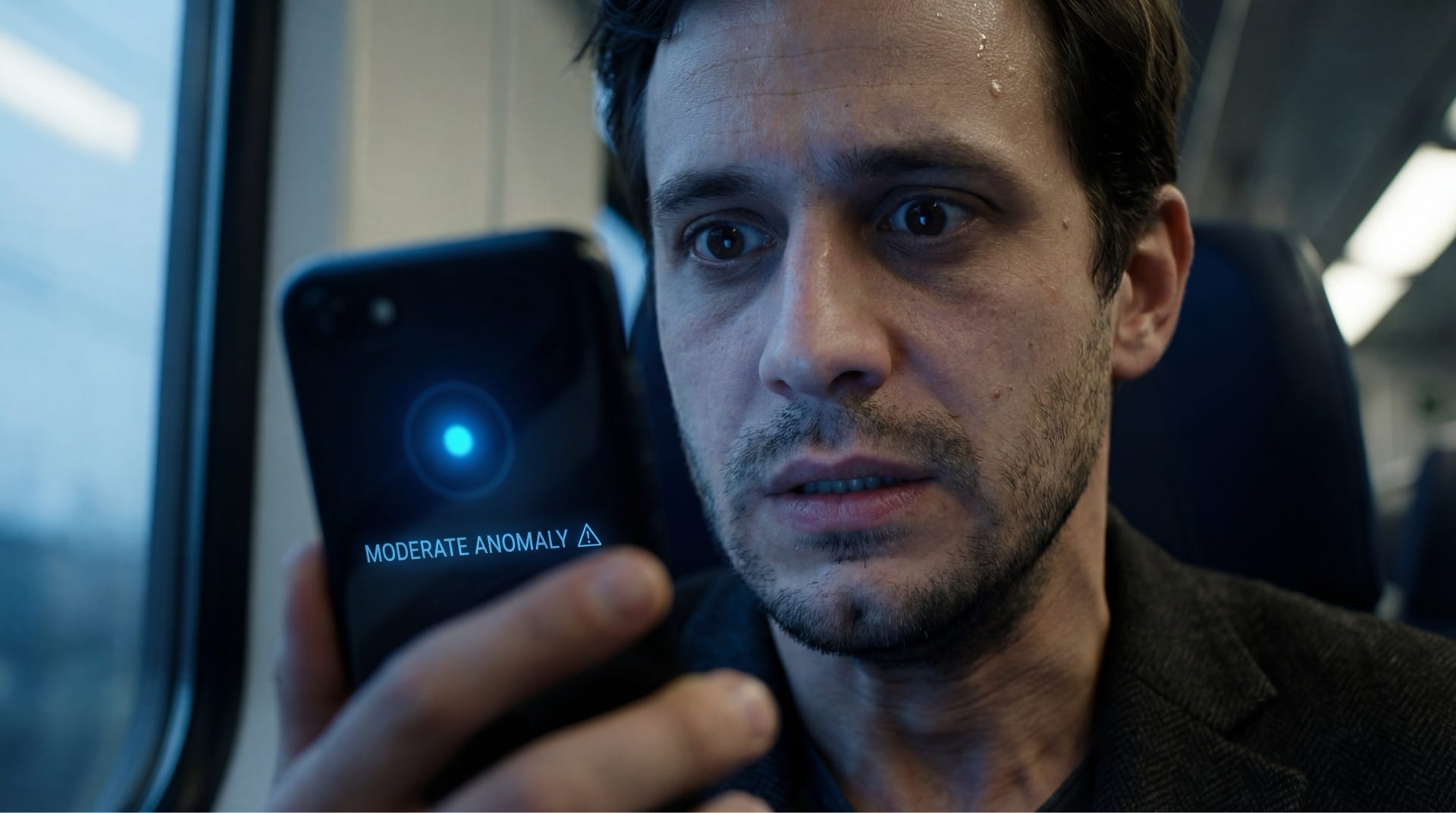
The station area. The platform. The carriage he sat in. A blue dot at the centre. A label:
MÜLLER, JAMIE. 32. RATING: 847. STATUS: MODERATE ANOMALY. ROUTE DEVIATION: PLUS 18 MIN. RECOMMENDATION: OBSERVE. PRIORITY: MEDIUM.
His throat tightened.
Moderate anomaly, he repeated to himself, as if it were a medical diagnosis for a disease not yet named.
He shifted the map. Other dots.
A red one:
WOMAN, 43. ACCOUNT FREEZE ACTIVE SINCE 04.01.2040. REASON: PAYMENTS IN CATEGORY “CHARITY” (EUR 340). DURATION: 14 DAYS.
A yellow one:
MAN, 58. LIMIT REDUCED BY 30 PERCENT. REASON: ALCOHOL PURCHASES ABOVE NORM.
A green one:
24 YEARS. RATING: 920. STATUS: STABLE.
He scrolled up. A tab: ACTIVE ORDERS.
A list of names and statuses. Priorities to the right.
He scrolled mechanically until he saw:
DE VRIES, MAX. PRIORITY: CRITICAL. SEARCH ACTIVE. LAST KNOWN LOCATION: CHURCH OF THE AZAMS, MUNICH. 05.01.2040, 21:47. SUSPICION: LINK TO DFT 21 LEAK. ACTION: DETAIN UPON SIGHT.
Critical, Jamie thought.
An hour ago he had sat across from that “critical” man. He had breathed bookshop air, listened to his steady voice, accepted the flash drive.
Automatically, he scanned down the list again, looking for himself.
He was not among the active orders.
Not yet.
The screen jerked and went black for a second. Then it returned to normal: weather, news, ratings.
The administrative panel vanished.
Jamie sat gripping the phone hard enough to whiten his knuckles.
A glitch, he told himself. It happens. The system is perfect, of course, but it has a sense of humour.
Only it was the kind of glitch that makes you want to check the corners of every room.
The train stopped.
— Ostbahnhof, the speaker announced.
Jamie stood and stepped onto the platform.
On the way up, his eyes counted stairs automatically, noted cameras, searched for blind spots. Paris, twenty eight, rooftops over Marseille, it all lived in muscle memory.
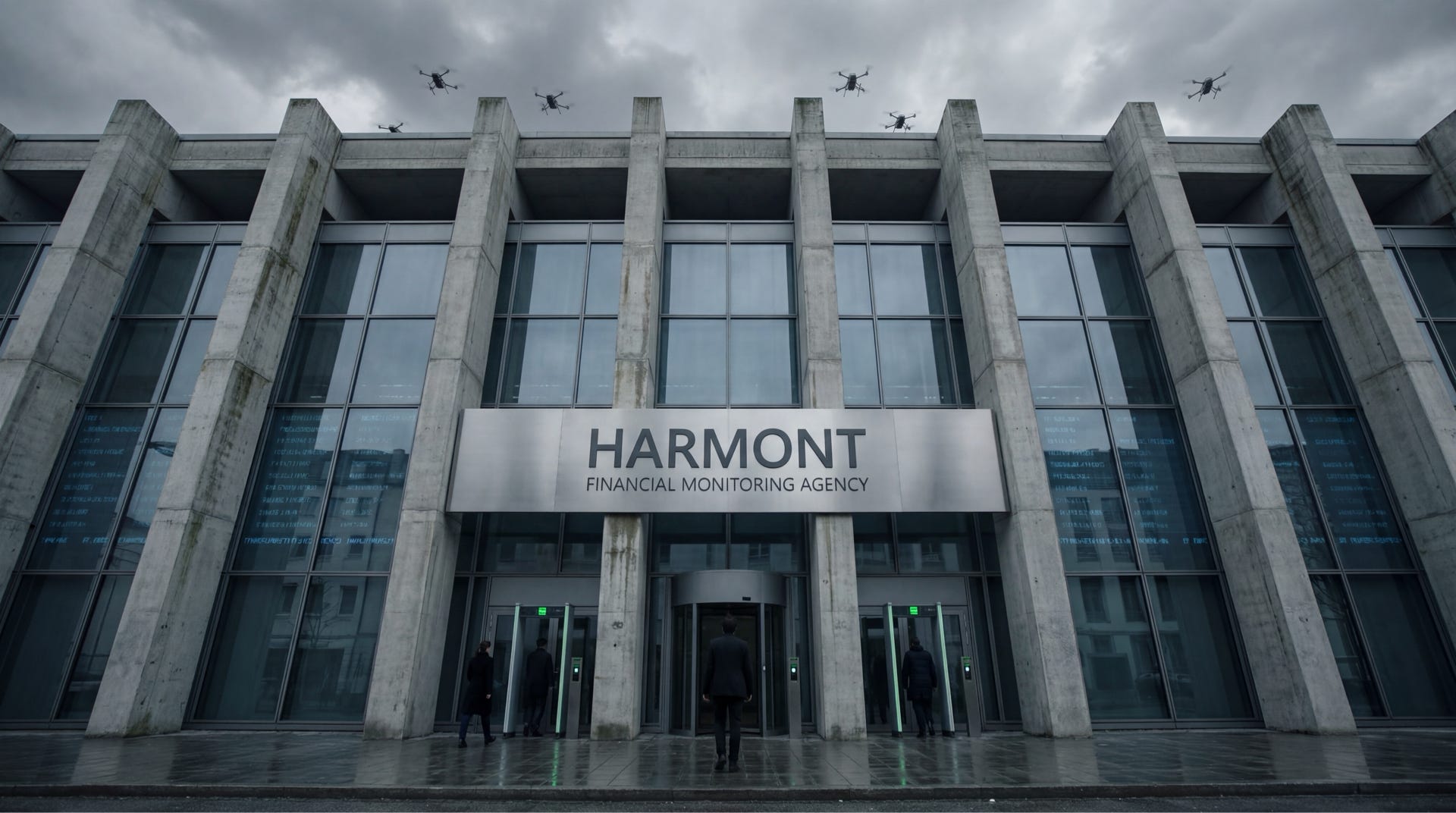
The Agency, he thought. My favourite institution. Home, homeland, a caring god.
The Harmont Financial Monitoring Agency building looked like a museum and a crematorium at once. Glass everywhere, concrete everywhere, everything transparent, everything heavy.
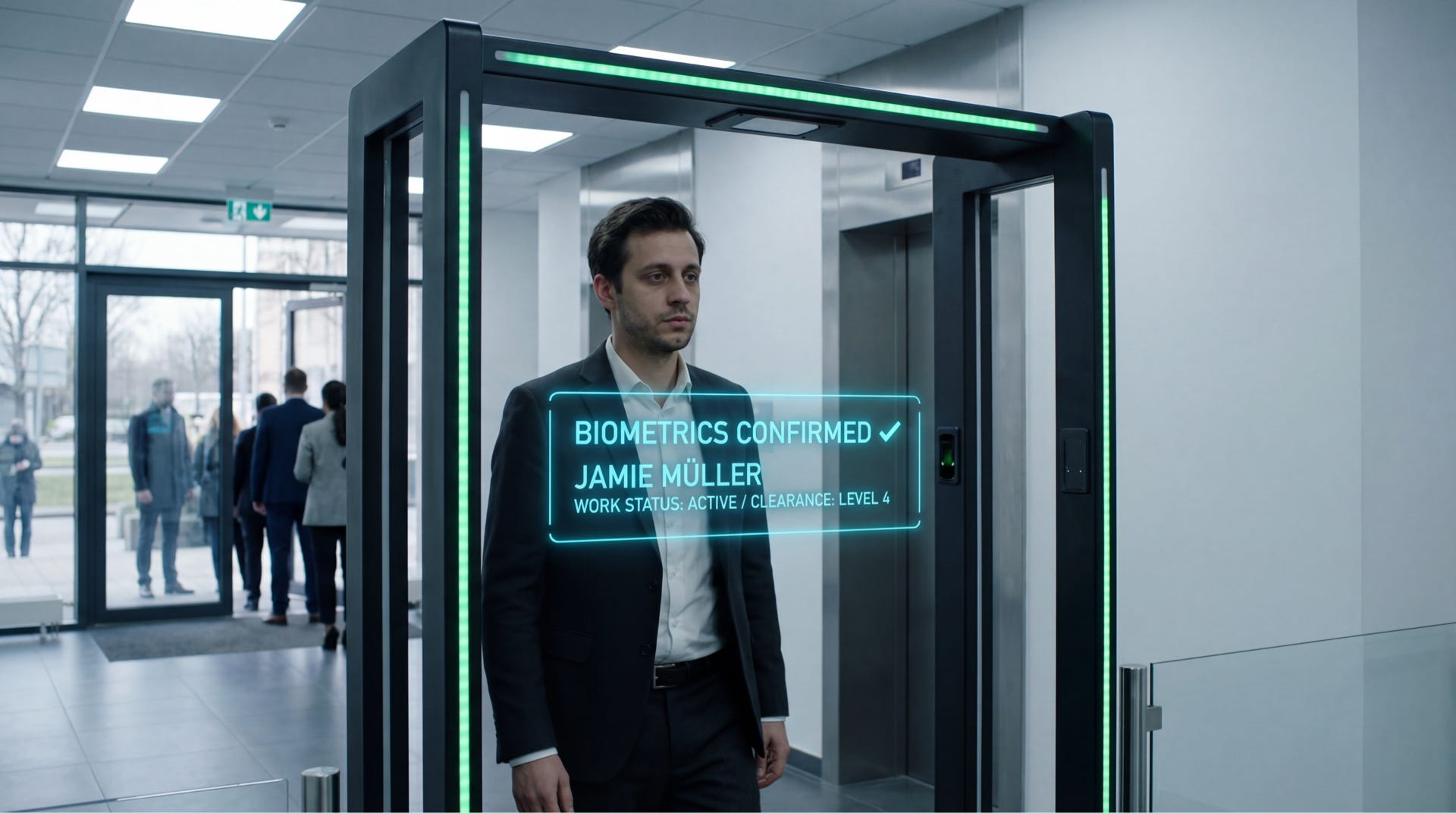
At the entrance, a scanner frame.
— Welcome, Jamie, the familiar security voice said. — Your biometrics are confirmed. Work status: active.
Erica was waiting at his desk. She was everywhere, in his earpiece, on his monitor, in the server room. A voice that knew his statistics better than his ex girlfriend.
— Good morning, Jamie, Erica said. — You have forty seven unreviewed transactions. I recommend starting with the reds. Critical anomalies: seven. Average processing time per case: four minutes.
— Understood, he said.
Three screens. Left: real time transaction flow. Middle: connection graphs, the Payment Integrity Graph in all its branching beauty. Right: citizen profiles with neat photographs, ratings, and short summaries.
Work, he thought. Nothing personal. Just little squares and circles.
He opened the first red anomaly. Woman, 43, a familiar name. On the train he had seen her as a red dot. Charity, three hundred forty euros, “suspicious activity”.
— System recommendation: keep the freeze, Erica said. — Probability of connection to illicit flows: sixty seven percent.
— Grounds.
— Payments to three foundations, one of which is in a heightened risk zone. Pattern: high regularity, small sums.

He looked at the graph.
Maybe she is feeding some orphan farm, he thought. Maybe she simply has a soft heart.
Out loud, he said something else:
— Keep it.
— Decision recorded, Erica said. — Trust level in the monitoring system increased by zero point zero three percent.
At fourteen hundred they held a meeting.
The VR glasses were light, barely there. Once you put them on, the world changed. No office with noisy printers, but a white hall without windows, a glass table, colleagues as avatars. Everyone looked like a brochure, perfectly groomed, smooth, nothing out of place.
The department head, a strict woman in her early fifties who in reality slouched slightly, spoke now with perfect posture in the virtual room.
— Colleagues, we have a new directive from the Ministry of Financial Freedom, her projection said. — Liberton is announcing the Law on the Democratisation of Payments. Independent Electronic Money Institutions will be integrated into the unified system. Our task is to ensure a smooth transition and identify all anomalous links.
Smooth transition, Jamie echoed silently. Heard it. Seen it.
— We are intensifying monitoring of these institutions’ transactions for the last six months, she continued. — Any signs of compliance bypass go into a separate report.
Colleagues’ avatars nodded in sync. Smiled. Agreed.
Erica whispered in his ear:
— I have flagged twenty eight EMIs with elevated risk. I can sort them by probability of violation.
— Later, Jamie said.
— Your stress level has risen by twenty three percent, Erica reported. — I recommend a pause and breathing exercises.
— Not now.
— Acknowledged. Reminder moved to sixteen hundred.
Yes, God is merciful, Jamie thought. It even lets you breathe on a schedule.
The workday stretched like chewing gum from the eighties. Not poison, but the flavour had ended a long time ago. By evening, the graphs merged into one grey web.
At nineteen hundred he shut down his terminal. Erica said:
— Thank you for an efficient day, Jamie. Your KPI today is six percent above average.
— Happy for both of us, he replied.
He took off the jacket only in the toilet. Five minutes without sensors, a small island of anonymity in an ocean of transparency.
Then he went outside.
The streetlights adjusted their brightness to his steps again. At one point he wanted to cut sharply, jump onto a windowsill, grab a drainpipe, climb up and vanish onto a rooftop, like in Marseille years ago.
But he simply walked home. Like a proper blue dot with “medium observation priority”.
The apartment met him with silence and a list of notifications, but he shut everything off.
He pulled the flash drive from his backpack. The metal felt as cold as it had in the morning.
From under the desk he dragged out an old laptop, heavy, angular, its casing scratched. No comms modules. Always powered off until the moment it was needed.
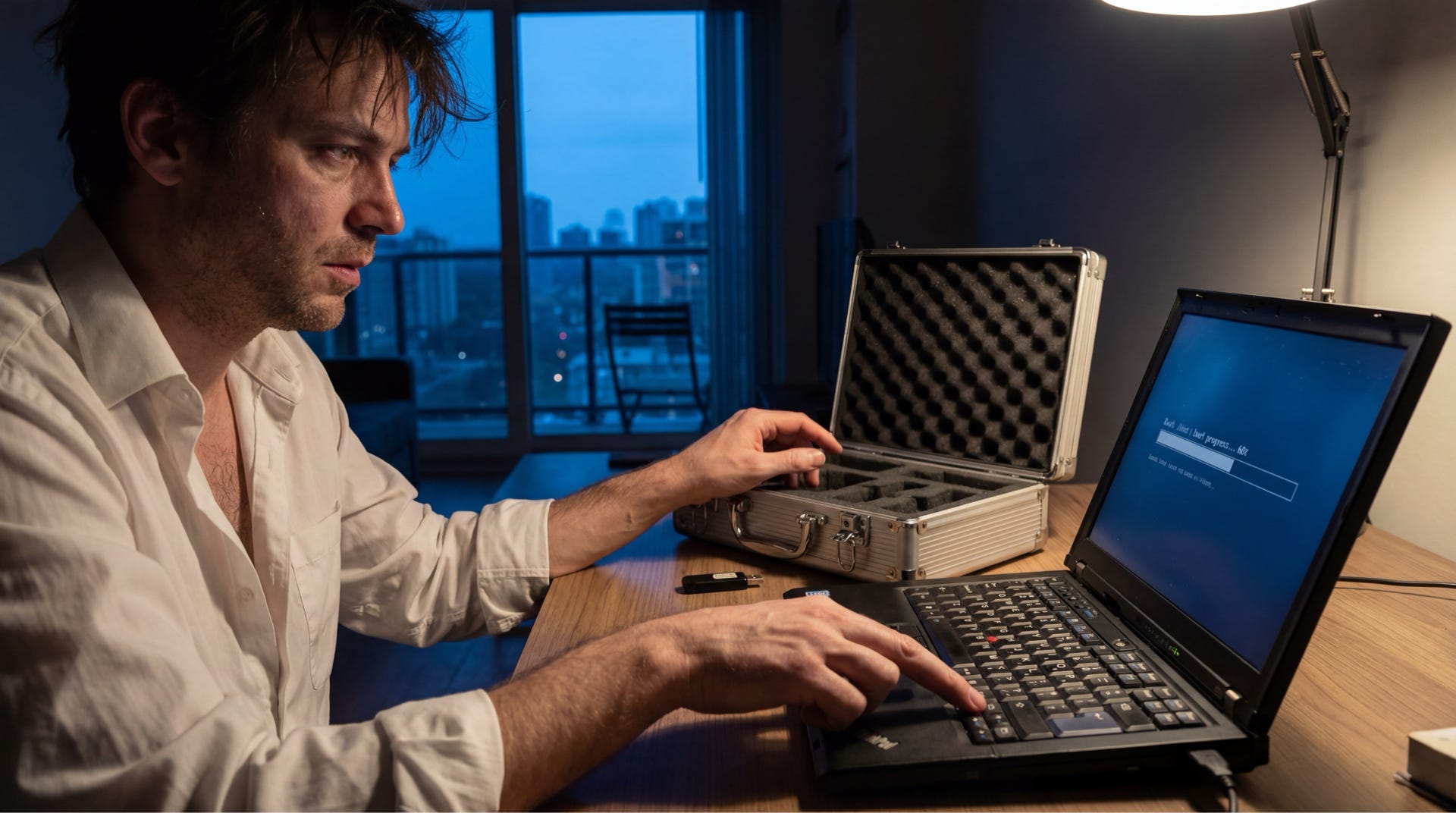
He plugged in the drive.
The encryption was not especially complex, just old fashioned. The first file opened. A document with dry headers: “Internal Memo, Directorate General for Financial Stability.” Date: 2027.
He read one paragraph, then another.
“…It is proposed to integrate the Retroactive Compliance mechanism into the PSD3 framework, using AML directives as the legal basis. Public consultations are not to be conducted due to urgency and the risk of politicisation…”
Of course, he thought. Public consultations are when people are allowed to watch their own execution.
The third file was called simply: “Missing_2024_2026”.
He opened it without much expectation.
A list. Surname, name, age, profession, disappearance date, a short note.
He scrolled down.
There were people he remembered from the news. Journalists, activists, former regulatory staff. In most cases, a dry line: “disappeared under unclear circumstances”.
Then he saw it.
“Müller, Thomas. 47. Journalist. Missing: March 2025. Munich. Investigated PSD2 implementation and preparations for PSD3. Last piece: interviews with European Commission insiders. Publication did not occur. Disappeared three days before planned release.”
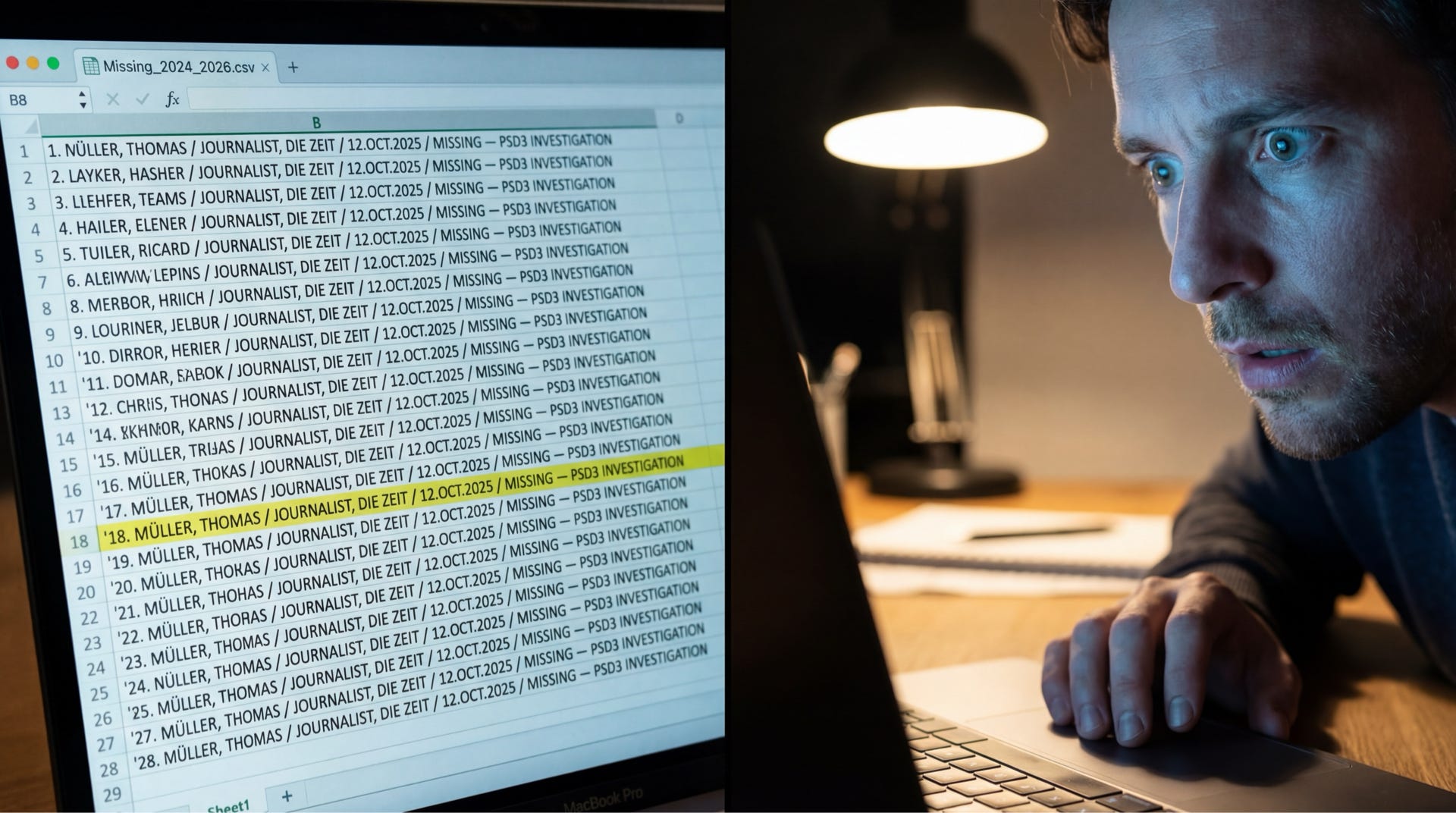
The world, already far from stable, flipped. The air in the room compressed, dense as glass. Jamie stared at the screen, reading the name again. And again.
Thomas Müller.
His father.
He closed his eyes.
Kitchen. Winter.
His father sits opposite him. A coffee cup in his hands. A tired face. A look as if there is little time and too much to say.
— Whatever happens, I regret nothing, his father said.
— Why are you saying that, sixteen year old Jamie asked.
— Because the world is changing, Thomas replied. — Quietly, under the table. And it is not guaranteed it is for the better.
He ruffled Jamie’s hair, awkwardly, as if he had not practised the gesture in a long time.
— I am not ashamed of my life, he said. — I did what I believed was right.
Then he leaned closer.
— Be careful, Jamie. Be attentive. And most of all, do not betray yourself.
— What does that mean.
— Do not do what you cannot explain to yourself, his father said. — The world will demand that you stay silent and agree. But if you betray yourself, you will have nothing left.
He stood, took his jacket, and left.
Three months later, he vanished.
It was their last conversation.
Jamie opened his eyes.
On the laptop screen, the name glowed: “Müller, Thomas”.
— They took you out.
He grabbed his phone and opened an encrypted channel.
He typed:
“I’m in. Fully.”
Recipient: Max Vries.
The message blinked and sent. The room went dark.
I hope all this doesn't become true....But, with all the stuff going on in the world - I can't hope for good. BTW, props for the creativity!
We're already living in the beta version of Jamie's world. My smart home definitely judges my 2am decisions, just less politely lol